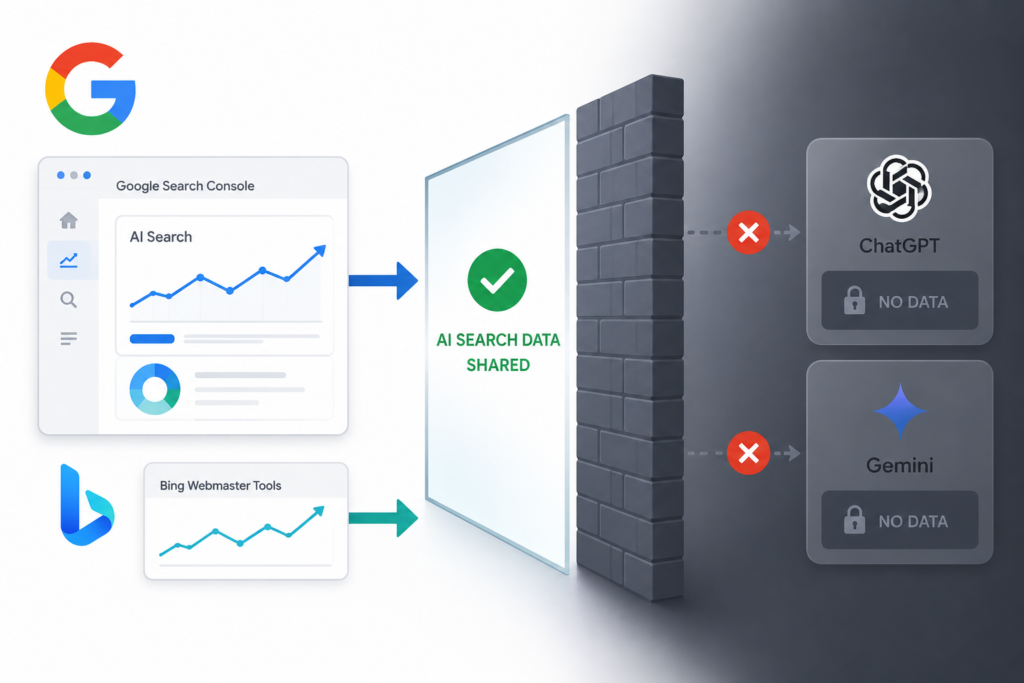
Official AI search performance data from Google is finally here, and for generative engine optimization that’s a big deal. Bing had announced the same in Feb 2026. Publishers can measure how visible they are in AI search features using first-party tools. But the picture is only half-finished. The two largest AI search platforms by market share, ChatGPT and Gemini, give you nothing, so most AI search visibility still goes unmeasured.
What Google actually announced:
On June 3, 2026, Google announced new Search Generative AI performance reports in Search Console. The official announcement states:
“Today, we’re excited to announce the launch of new Search Generative AI performance reports in Search Console, including dedicated reports for Search and Discover, to help you understand your site’s visibility within generative AI features on Search.”
Source: https://developers.google.com/search/blog/2026/06/gen-ai-performance-reports
The reports give you specific metrics for AI Overviews, AI Mode, and generative AI features in Discover. The key metrics:
Impressions: How often URLs from your site appeared in generative AI features in Search and Discover
Pages: Check which URLs appeared within AI features
Countries: Understand your visibility on a country basis
Devices: Identify the devices people are using when seeing your website (available for Search results)
Dates: Monitor your performance over time with hourly, daily, weekly, and monthly granularity
The impressions-only move is deliberate
Let me say this plainly, because it is my personal view and I am not going to dress it up. Google is giving you impressions only, and it is leaving clicks out on purpose. This is not some technical limitation that they are still working on. It is a choice.
Here is what is actually going on. AI Overviews and AI Mode are the features that are killing the click. The user is getting the full answer sitting right there on the page, and they are never coming through to your site at all. That is the whole zero-click problem, and the click-through rates on these AI surfaces are running low, sometimes embarrassingly low. So Google is doing the smart thing for Google. It is showing you a clean impressions number that is looking healthy, and it is quietly keeping the click data off the table, because the click data is the number that is exposing how little of that shiny visibility is actually turning into traffic for you. You are getting to see that you appeared. You are not getting to see how badly the click is leaking on the way to your site. And in my view, that gap is not a coincidence, it is the point.
And Google is being cautious about the rollout too. In their words, “We are rolling these reports out to a subset of websites, allowing us to thoroughly test them and receive feedback before making them widely available.” So if you are not seeing it yet, that is why.
Source: https://developers.google.com/search/blog/2026/06/gen-ai-performance-reports
What Bing announced earlier
Bing got there first, introducing AI Performance in Bing Webmaster Tools back in February 2026. The announcement states:
“We are happy to introduce AI Performance in Bing Webmaster Tools, a new set of insights that shows how publisher content appears across Microsoft Copilot, AI-generated summaries in Bing, and select partner integrations. For the first time, you can understand how often your content is cited in generative answers, with clear visibility into which URLs are referenced and how citation activity changes over time.”
Source: https://blogs.bing.com/webmaster/February-2026/Introducing-AI-Performance-in-Bing-Webmaster-Tools-Public-Preview
Bing’s dashboard takes a different angle, built around citations:
Total Citations: Shows the total number of citations displayed as sources in AI-generated answers
Average Cited Pages: Shows the average number of unique pages from your site cited per day
Grounding queries: Shows the key phrases the AI used when retrieving content
Page-level citation activity: Shows citation counts for specific URLs
Source: https://blogs.bing.com/webmaster/February-2026/Introducing-AI-Performance-in-Bing-Webmaster-Tools-Public-Preview
The difference that matters: Google and Bing hand you official analytics. ChatGPT and Gemini, as a standalone platform, do not.
What this means for GEO research
You now have official data for the platforms that bother to provide it, but those platforms are the minority of AI search traffic. If you’re optimizing for AI search visibility, you still have to lean on third-party tools or inferred metrics for ChatGPT, which is where most AI chatbot traffic actually goes.
The gap creates real blind spots. Say your content does well in Google and Bing AI features but tanks in ChatGPT. You have nothing official to diagnose with in terms of search volume on those queries.
Bottom line
Google and Bing both give you official data on AI search performance now, which ends the guessing game for their platforms. But ChatGPT, which carries most AI chatbot traffic, and Gemini as a standalone platform offer you nothing. So the shift is real and it’s only half-done. Use the official data where you can get it, and stay honest that most AI search visibility is still invisible to first-party tools.