For two decades, when Google published guidance on Search, the SEO industry treated it as the word of God. That instinct was earned. Google ran the search market, so Google’s documentation effectively was the manual.
Last week, Google published “Optimizing your website for generative AI features on Google Search.” Within forty-eight hours, half of marketing people on LinkedIn had reposted it as the definitive guide to AEO and GEO. The carousels, the screenshots, the hot takes, the consultants declaring “AEO is dead, just do SEO.”
The reflex is firing in the wrong category.
AEO is the practice of getting brands surfaced inside LLM-generated answers. The LLM answer market is multi-engine and ChatGPT-led. By usage and by citation share, Google sits third or worse on the surface that actually defines AEO. A guide from a third-place player, scoped explicitly to AI features inside Google Search, and not even covering Google’s own AI assistant Gemini, cannot be the AEO bible. Treating it as one is reflex, not analysis.
Here is the argument, in five points.
1. By Google’s own title, this is not an AEO guide.
The guide is titled “Optimizing your website for generative AI features on Google Search.” Read the title three times. “Google Search,” not “AI assistants.” “Generative AI features on” Google Search, meaning AI Overviews and AI Mode, not Gemini the standalone app. “Your website,” meaning one specific surface.
The guide does not cover ChatGPT. It does not cover Perplexity. It does not cover Claude. It does not cover Gemini the app, which is Google’s own dominant AI product with 750 million monthly active users as of Q4 2025.
Now look at where AEO actually happens. ChatGPT has 900 million weekly active users and processes more than 2 billion queries a day. By share of AI chatbot referrals in April 2026, ChatGPT holds 76.85%, Gemini holds 18 to 25% depending on the source, and Perplexity, Claude, and Copilot fight for the rest.
A guide that covers neither ChatGPT, the dominant assistant, nor Gemini the app, Google’s own number two, is not an AEO guide. Calling it one is the SEO community projecting a label Google itself did not claim.
2. Your website is the smallest surface in AEO.
Search has split into two systems. Google retrieves a list of pages it already has. An LLM generates a list of brands it computes to be statistically associated with the user’s intent. Two different machines, same interface, easy to confuse.
SEO is your site surfacing in a search engine. AEO is your brand surfacing in an LLM. The unit changes from page to brand, the optimization target changes from rank to citation, and the role of your own website collapses.
In the framework I have systematized as The AEO Process, the surfaces that build LLM brand associations are, in priority order: comparison content, third-party “best of” lists on high-trust domains, Reddit and forums, YouTube reviews and transcripts, athlete and event association, and finally, your own website. Six surfaces. The brand site is item six.
It is a floor, not a ceiling. Your site needs to exist and be indexable. It is not where AEO is fought.
Every recommendation in Google’s guide is addressed to that floor. Make your site indexable. Make it crawlable. Use semantic HTML. Write first-hand content on your pages. All of this is fine, all of this is necessary, and almost none of it moves citation share inside an LLM. The model is a compressed mirror of what the web has already said about your brand. The web is not your site.
3. The content advice fails the test in two minutes.
Google’s content recommendation is to write unique, first-hand, non-commodity content on your own site. The implicit promise is that if you do this well, ChatGPT and Perplexity will reward you with citations.
Run the experiment. Send “best running shoes” to ChatGPT. The brands surface, but the citations panel shows Runner’s World, The Run Testers, Reddit, Women’s Health, and TechRadar. Run “best walking shoes.” The panel shows GearLab, RunRepeat, Runner’s World, RunToTheFinish. Run “most comfortable sandals for men.” GearLab, GQ, Prevention, Reddit. Run “best razor for smooth shave.” Men’s Health, British GQ, TechGearLab, ShaverCheck. Run “where to buy auto accessories online.” The Car Expert, MAPerformance, Autofurnish, Amazon.
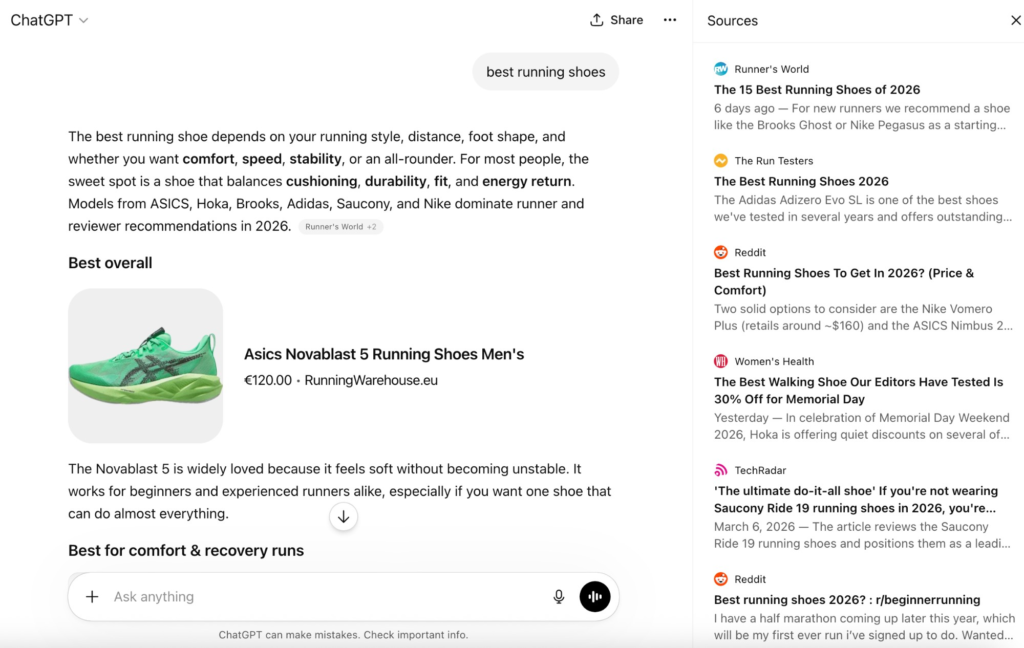
Five queries, five categories, roughly thirty citation slots. The number of brand manufacturer sites cited across all of them is zero.
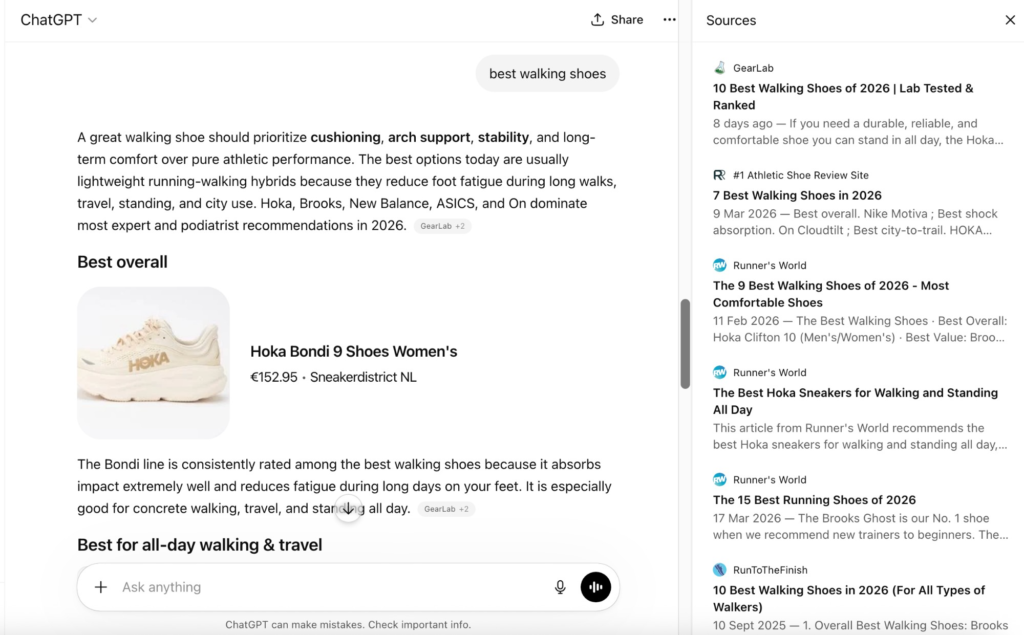
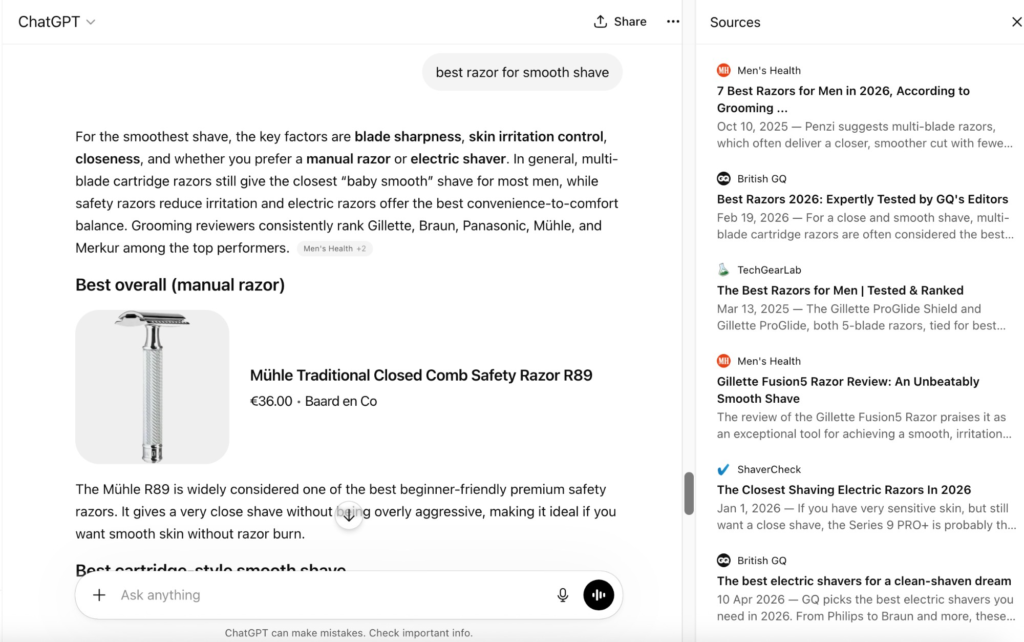
Nike, Hoka, Birkenstock, Gillette, and Braun all appear in the answer text. None of them appear in the sources panel. They surface because Runner’s World and GearLab and r/RunningShoeGeeks say they should, not because their own helpful, first-hand content on their own site convinced the model.
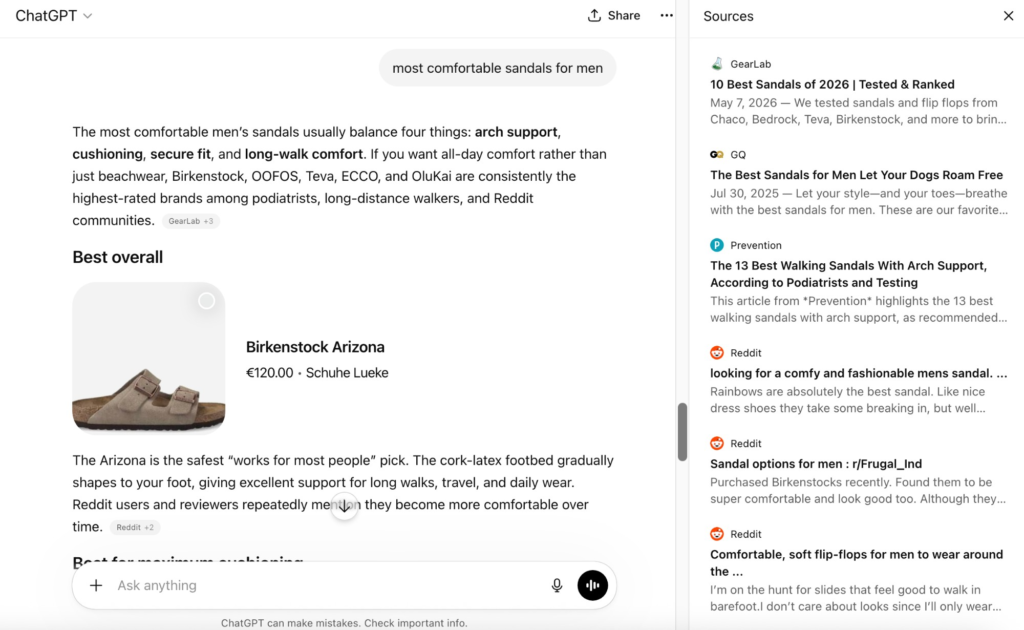
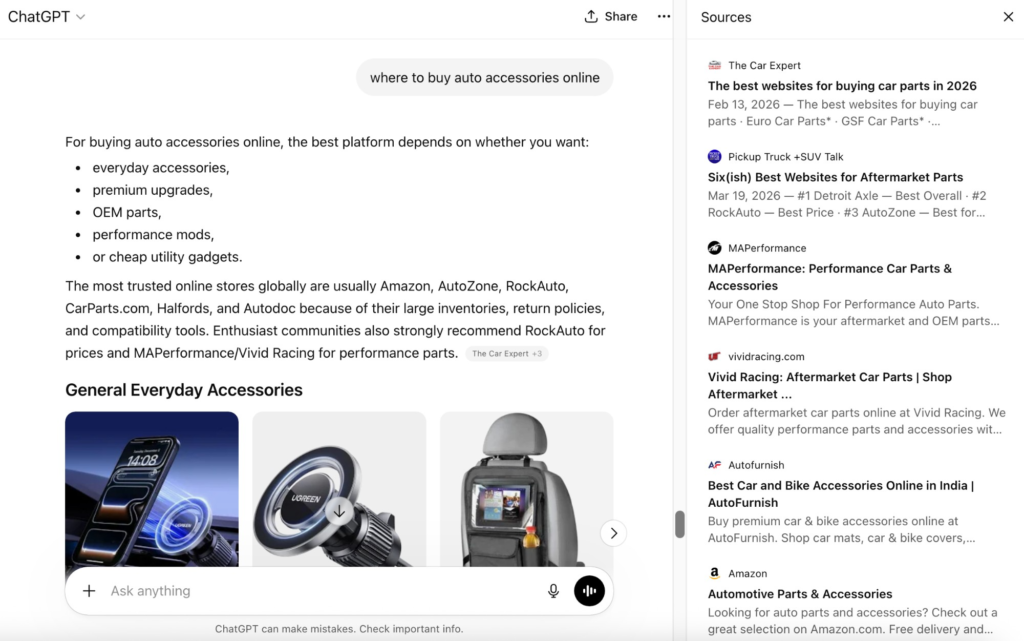
This is not a bug, it is the design. A model that cited Gillette.com to answer “best razor for smooth shave” would be a bad model. The good ones discount brand-owned content for competitive queries because the brand has an obvious conflict of interest.
Google’s content advice describes how to win the conflict-of-interest source. The model is engineered to discount that source. Run the experiment yourself before treating the advice as gospel.
4. The technical and mythbusting sections do not survive contact with the data.
The “Build a clear technical structure” section is the SEO 101 checklist. Indexability, crawlability, semantic HTML, JavaScript SEO, page experience, duplicate content, Search Console. Every bullet has been Google guidance for at least a decade. None of it is new, none of it is AEO-specific, and labeling it AEO is relabeling.
The “Mythbusting” section is more aggressive and less defensible. Google says you do not need to chunk content. Every serious retrieval-augmented generation pipeline is built on chunking, and how your content is structured on the page directly affects how cleanly it gets cut into retrievable passages. Telling authors not to think about it is, at best, a simplification.
Google says you do not need to chase mentions and implies content format does not matter. The data is the opposite. The 2026 Adweek study across ChatGPT, Gemini, and Perplexity found YouTube captures 39.2% of all AI citations and Reddit captures 20.3%. Reddit appears in 92.8% of citation opportunities across AI tools. Perplexity cites Reddit 6.1 times more than YouTube. ChatGPT skews toward Wikipedia at 47.9% of top citations, Google AI Overviews toward YouTube at 23.3%, Claude toward blogs at 43.8%.
These numbers are not random. They are the fingerprint of content format. Every Reddit thread is a question followed by a stack of answers, which is exactly the structure of an FAQ. Every popular YouTube video answers a question, usually in a how-to, comparison, or explainer frame, which is the structure of HowTo and Q&A content. These formats match the way users phrase questions to LLMs and the way LLMs phrase answers back. FAQ, Q&A, and HowTo are the formats winning citation share, regardless of whether the host is Reddit, YouTube, a third-party publisher, or your own site. Format is the strongest measurable signal in the AEO data. Telling brands to ignore it is telling them to ignore the data.
5. The Google-worshipping reflex does not transfer to the LLM era.
This is the real point. The SEO industry built a 20-year habit of treating Google’s word as authoritative because, in Search, it was authoritative. The habit is now firing on a category where Google is the third-place player.
AEO is a multi-engine discipline. It is defined by the surfaces that dominate it, by the platforms whose content the models actually cite, and by the practitioners whose frameworks survive contact with real campaigns. Google does not run those surfaces. ChatGPT is closer to running them, but even OpenAI does not get to declare what AEO is, because the actual citation share is owned by Reddit, YouTube, Wikipedia, and a long tail of third-party publishers nobody owns.
Calling Google’s guide the AEO bible is the SEO industry doing what it has always done, deferring to Google’s framing, on a category where Google’s framing is not the relevant frame. Google is, transparently, trying to position itself as the daddy of AEO. The market position does not support the posture. Twenty-five percent of one slice of the assistant market does not confer authority over the whole market.
The guide is useful for what it is. It is a Google Search guide with the word “generative” added. Treat it as that.
AEO is not about one site. LLMs are not about one site. This guide is about one site, on one feature, inside one of Google’s two AI products. The Google-worshipping era ended the day ChatGPT crossed 900 million weekly users. The industry just has not caught up yet.